


Table of Contents
- Types of Pet Grooming Brushes for Shedding
- Slicker Brush vs Undercoat Rake: Which One Works Better?
- How to Choose the Right Grooming Brush for Shedding
- How Often to Brush a Shedding Dog
- How to Reduce Dog Shedding at Home
- Ergonomics and Repetitive Strain: What Most Guides Ignore
- What to Look for When Buying a Shedding Brush
- Conclusion
Last Updated: August 27, 2026
Most dog owners underestimate how much the right brush matters. The best pet grooming brushes for shedding protect skin, distribute natural oils, and keep your home significantly cleaner between washes. At Quanolo, we've put together this guide to help you find the grooming tool that matches your dog's coat type.
The problem most guides get wrong is treating all shedding brushes as interchangeable. A slicker brush that works brilliantly on a Border Collie will do almost nothing for a Labrador's dense undercoat. Below, we cover every major brush type, explain exactly when to use each one, and flag the safety mistakes that can cause harm.
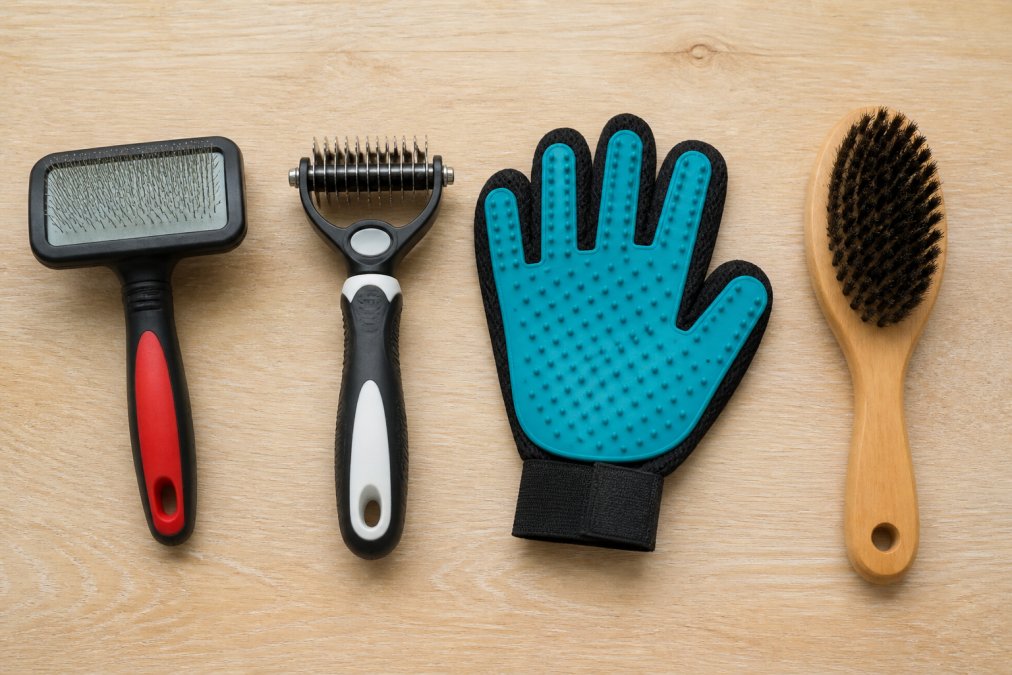
Types of Pet Grooming Brushes for Shedding
Grooming brushes for shedding fall into several distinct categories, each targeting a different layer of your dog's coat. Choosing the wrong type is the single most common mistake pet owners make.
Slicker Brushes
A slicker brush is a flat or slightly curved pad covered in fine, angled stainless steel pins. It works across the topcoat and upper undercoat, pulling out dead hair and smoothing the coat surface. Slicker brushes are effective on most coat types, which is why they appear in nearly every grooming kit.
They excel on medium to long-haired breeds and dogs prone to matting. They fall short on very short-haired breeds with minimal undercoat, where a bristle brush or grooming mitt works better. Pin density matters: widely spaced pins suit thick, dense coats; fine, closely spaced pins suit silkier coats. An ergonomic handle is also worth prioritising.
Deshedding Tools and Undercoat Rakes
A deshedding tool reaches past the topcoat to pull loose fur directly from the undercoat using a stainless steel edge or closely spaced tines. Undercoat rakes work similarly with longer, wider-spaced tines that penetrate deeply into double-coated breeds without scratching the skin.
These are essential for heavy seasonal shedding. Double-coated breeds like Huskies, German Shepherds, Golden Retrievers, and Corgis blow their coats twice a year, and a standard slicker brush cannot keep up. An undercoat rake used correctly can dramatically reduce fur removal burden during peak shedding cycles. Used with too much pressure, however, deshedding tools can cause brush burn and skin irritation. Technique matters enormously.
Bristle Brushes, Grooming Mitts and Curry Combs
Bristle brushes use natural or synthetic bristles to smooth the topcoat, distribute natural oils, and add shine. They are most effective on short-haired and single-coated dogs. A grooming mitt slips over your hand and lets you stroke fur away naturally. Dogs that resist traditional brushes often accept mitts because the motion mimics petting. They are particularly useful for dogs with skin sensitivity.
A curry comb, a rubber or plastic oval with short teeth, functions similarly to a grooming mitt but with a handle. It works well on short-haired breeds and is excellent at lifting fur and dander from the coat surface.
| Brush Type | Best Coat Type | Primary Function | Shedding Effectiveness |
|---|---|---|---|
| Slicker brush | Medium to long, any texture | Detangling, dead hair removal | High |
| Deshedding tool | Double-coated, heavy shedders | Undercoat fur removal | Very high |
| Undercoat rake | Thick, dense double coats | Deep undercoat clearing | Very high |
| Bristle brush | Short-haired, single-coated | Topcoat smoothing, oil distribution | Moderate |
| Grooming mitt | Short to medium, sensitive skin | Gentle fur removal, massage | Moderate |
| Curry comb | Short-haired | Lifting fur and dander | Moderate |
Slicker Brush vs Undercoat Rake: Which One Works Better?
They solve different problems, and most double-coated dogs need both.
A slicker brush handles the topcoat and catches loose fur at the surface level. It is faster to use, gentler on the skin, and appropriate for regular maintenance sessions two to three times per week. An undercoat rake goes deeper, targeting the dense layer of soft fur beneath the topcoat responsible for most shedding. During peak seasonal shedding, an undercoat rake used once or twice a week can reduce overall fur fall meaningfully.
Use a slicker brush for routine grooming and bring in the undercoat rake during heavy shedding periods or when you can feel a thick, woolly layer beneath the topcoat. For short-haired, single-coated dogs, a slicker brush is usually sufficient.
How to Choose the Right Grooming Brush for Shedding
Selecting the right grooming brush comes down to coat type, coat length, and skin sensitivity, in that order.
Short-Haired and Single-Coated Dogs
Short-haired breeds such as Beagles, Boxers, and Dalmatians shed consistently but lightly. Their coats sit close to the skin, so deep-penetrating tools like undercoat rakes are unnecessary and can cause irritation. A grooming mitt or curry comb is most effective, as the rubber nubs grip loose fur efficiently without applying pressure to the skin. A bristle brush used after the mitt smooths the topcoat and distributes natural oils. Brushing two to three times per week is usually sufficient outside of seasonal peaks.
Long-Haired and Double-Coated Breeds
Long-haired and double-coated breeds require a layered approach. According to The Kennel Club's breed grooming guidance, double-coated breeds need regular brushing to prevent matting, which can trap moisture against the skin and cause dermatitis.
Start with an undercoat rake or wide-toothed comb to work through tangles, moving in the direction of coat growth. Follow with a slicker brush to remove loosened dead hair and smooth the topcoat. Finish with a bristle brush to add shine and distribute oils. Back brushing, brushing against the direction of coat growth, is useful for lifting fur but use it sparingly on sensitive skin.
How Often to Brush a Shedding Dog
For most double-coated breeds in their normal coat phase, three to four sessions per week maintains coat health and keeps loose fur under control. During seasonal shedding in spring and autumn, daily brushing is more effective and prevents matting. Short-haired, single-coated dogs can often be maintained with two sessions per week.
If you run your hand along your dog's coat and come away with visible fur, it is time to brush. Waiting until you can see fur on the furniture means you are already behind the shedding cycle.
How to Reduce Dog Shedding at Home
Reducing shedding at home is largely a question of consistency. No brush eliminates shedding entirely, but regular grooming significantly reduces loose fur in your living space.
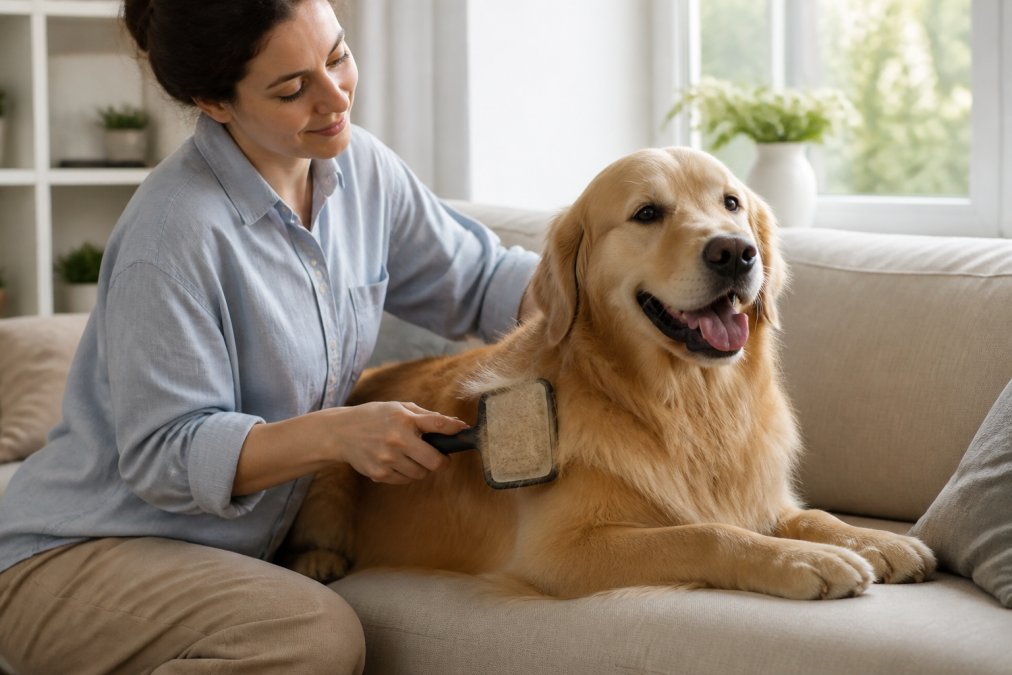
The most effective home strategy combines frequent brushing, a balanced diet, and appropriate bathing. Nutrition directly affects coat health: a diet deficient in essential fatty acids produces a dull coat that sheds more heavily. As noted by the PDSA's guidance on dog coat care, a healthy coat starts from the inside.
Bathing with a de-shedding shampoo once every four to six weeks loosens dead hair and makes subsequent brushing significantly more effective. Brush thoroughly before bathing to remove tangles, then brush again once the coat is fully dry.
Grooming Technique: Avoiding Brush Burn and Skin Irritation
Brush burn occurs when a brush is dragged repeatedly over the same area with too much pressure, abrading the top layer of skin. Signs include redness, flaking, and a dog that flinches during grooming.
Apply light, consistent strokes rather than heavy pressure. Let the brush do the work. On a slicker brush, the pins should flex slightly on contact; if they press flat, you are pressing too hard. On an undercoat rake, the tines should glide through the coat; resistance means you have hit a tangle, which should be worked out with a detangling comb before continuing.
Work systematically across the whole coat rather than focusing on areas where fur is visibly thicker. Pay particular attention to areas prone to matting: behind the ears, under the collar, in the armpits, and around the hindquarters.
Ergonomics and Repetitive Strain: What Most Guides Ignore
Grooming a large, double-coated dog takes time. A thorough session can run to twenty or thirty minutes, and if you are doing this several times a week, the cumulative strain on your wrist, hand, and forearm is real.
Most grooming guides focus entirely on what the tool does to the dog, not what repeated use does to the person holding it. Key factors in an ergonomic handle: a non-slip grip that does not require a tight pinch hold, a handle angled to keep the wrist neutral, and weight distribution that places mass in the palm rather than fingertips. Rubber or soft-touch grip materials reduce vibration and allow a relaxed hold.
If you experience wrist or hand discomfort, a grooming mitt is worth considering as an alternative. Take breaks during longer sessions and switch hands periodically to reduce repetitive strain injury risk.
What to Look for When Buying a Shedding Brush
The market for grooming brushes is crowded with wide quality ranges. These specifications actually matter.
Pin or tine material: Stainless steel pins and tines hold their shape, resist corrosion, and are easier to clean than coated alternatives. Avoid tools where pins bend easily under light pressure.
Pin tip finish: Slicker brush pins should be rounded or ball-tipped to prevent scratching the skin. Sharp, unfinished tips cause irritation, particularly on sensitive skin.
Ease of cleaning: A brush difficult to clean accumulates dead hair, dander, and bacteria. Look for designs where the pin pad compresses to release trapped fur or where tines are spaced for easy removal.
Handle comfort and grip: Ergonomics matter for the person using the tool. A comfortable two-minute test will feel very different after twenty minutes of use.
Coat-specific design: General-purpose brushes are a reasonable starting point, but tools designed for specific coat types outperform generic options.
According to the RSPCA's advice on dog grooming equipment, the right grooming tools for your dog's specific coat type make the process more comfortable for both dog and owner and reduce skin problems caused by inappropriate brushing.
Quanolo's pet care range includes grooming tools selected for practical performance and owner comfort. Visit the Quanolo shop to see current options and check availability.
| Feature | Why It Matters | What to Look For |
|---|---|---|
| Pin tip finish | Prevents skin scratching | Rounded or ball-tipped ends |
| Handle ergonomics | Reduces repetitive strain | Angled grip, non-slip material |
| Pin material | Durability and hygiene | Stainless steel, corrosion-resistant |
| Coat-specific design | Effectiveness by coat type | Tine spacing matched to coat density |
| Ease of cleaning | Hygiene and longevity | Compressible pad or wide-spaced tines |
Match the tool to the coat first, then evaluate build quality and ergonomics. A well-made brush suited to your dog's coat texture will outperform a premium-branded tool designed for a different coat type.
For further reading on coat health and seasonal shedding patterns, the Blue Cross guide to dog grooming provides practical, vet-informed advice on maintaining coat condition across different breeds.
Keeping up with a heavy shedder is a genuine daily challenge, and the wrong brush makes it harder. Matching your grooming tool to your dog's specific coat type, using correct technique to avoid skin irritation, and building a consistent routine make the biggest difference. Quanolo's pet care range is built around practical, well-designed products that solve real problems. Shop now to find grooming tools that work for your dog's coat and fit comfortably in your hand.
Frequently Asked Questions
Q: What is the best brush for reducing dog shedding?
A: For most dogs, a deshedding tool with stainless steel pins is an effective option for removing dead hair from the undercoat before it falls around your home. Double-coated breeds benefit most from an undercoat rake used weekly, while short-haired dogs often do well with a grooming mitt or rubber curry comb. The best grooming brushes for shedding depend on your dog's coat type, so matching the tool to the coat texture matters more than any single product recommendation.
Q: How often should I use a deshedding tool on my dog?
A: During peak seasonal shedding, typically spring and autumn, most dogs benefit from deshedding sessions two to three times per week. Outside of these shedding cycles, once a week is usually sufficient to maintain coat health and reduce loose fur. Avoid using a deshedding tool daily on the same area, as over-grooming can irritate the skin and damage the topcoat. Always check the skin for redness after each session, especially on dogs with skin sensitivity.
Q: What is the difference between a slicker brush and a deshedding rake?
A: A slicker brush uses fine, angled wire pins set close together to remove loose fur, detangle the topcoat and smooth the coat surface. It works well on most coat lengths and is gentle enough for regular use. An undercoat rake has wider, longer stainless steel teeth designed to reach through the topcoat and pull dead hair directly from the undercoat. For heavy shedders and double-coated breeds, the rake removes significantly more fur per session than a slicker brush alone.
Q: Are deshedding brushes safe for all coat types?
A: Deshedding tools are safe for most double-coated and long-haired dogs when used correctly, but they are not suitable for every coat. Dogs with very short, single-layer coats, such as Greyhounds or Boxers, can experience skin irritation or brush burn if a rake is used too firmly. Curly or wavy coats can mat further if the wrong tool is used. Always apply light pressure, brush in the direction of fur growth, and stop if you notice redness or the dog shows signs of discomfort.
Q: How do I reduce dog shedding at home without professional grooming?
A: Consistent brushing is the single most effective way to reduce shedding at home. Combine a weekly undercoat rake session with daily or every-other-day brushing using a slicker brush or grooming mitt. Bathing your dog every four to six weeks helps loosen dead hair and supports natural oil distribution across the coat. Ensure your dog's diet includes adequate omega fatty acids, as coat condition is closely linked to nutrition. A grooming routine maintained year-round reduces seasonal shedding spikes noticeably.