


Table of Contents
- Essential Cooking Tools for First Apartment Kitchens
- How to Stock a Kitchen for Beginners Without Wasting Money
- Useful Kitchen Gadgets for Small Spaces That Earn Their Cupboard Space
- Chef's Knife, Cutting Boards and the Prep Tools Beginners Actually Use
- Pots, Pans and Measuring Tools: The Easy Kitchen Tools That Do the Heavy Lifting
- Ergonomic Kitchen Tools for Hands That Tire Easily
- Cleaning and Storing Your Kitchen Tools So They Last
- Frequently Asked Questions
Last Updated: September 16, 2026
Essential Cooking Tools for First Apartment Kitchens
The single biggest mistake new cooks make is buying a 20-piece knife block before they've boiled an egg. Easy kitchen tools for beginner cooks are not about quantity; they are about picking a small set of reliable items that cover chopping, heating, mixing and straining. This guide from Quanolo breaks down exactly what earns its place on a small worktop, what to skip, and how to keep each piece working for years. According to BBC Good Food's kitchen equipment guidance, a focused set of basics outperforms a drawer full of single-use gadgets every time.
A useful kitchen is built in layers. Start with the five or six tools you will touch daily, then add pieces as your cooking expands. That approach keeps costs down and stops cupboards filling with things you never reach for.
How to Stock a Kitchen for Beginners Without Wasting Money
Stocking a kitchen for beginners works best in three tiers: a core set you buy first, a second tier you add once you cook regularly, and optional extras you only buy for a specific dish. Most new cooks overspend on tier three before they own tier one.
Here is how to think about the spend:
| Tier | What Goes In It | When to Buy | Budget Approach |
|---|---|---|---|
| Core | Chef's knife, board, one pan, one pot, measuring cups and spoons, spatula, colander | Week one | Buy the best you can afford once |
| Second | Whisk, tongs, mixing bowls, grater, peeler | After a month of cooking | Mid-range is fine |
| Optional | Zester, kitchen shears, extra pans, specialty moulds | Only for a specific recipe | Borrow or buy cheap |
The rule that saves the most money: never buy a tool for a dish you have not yet cooked. A zester is a brilliant purchase the week you start cooking fish, and a waste of drawer space before that.
Useful Kitchen Gadgets for Small Spaces That Earn Their Cupboard Space
Useful kitchen gadgets for small spaces have one thing in common: they do more than one job. A single tool that chops, measures or stores in a compact footprint beats three that each do one thing and clutter the worktop.
Look for tools that nest, stack or hang. A colander that folds flat, a measuring cup that doubles as a jug, or a board that hangs on a hook all free up space. Multi-purpose tools are not a compromise; in a small kitchen they are the sensible default.
- Nesting mixing bowls stack into the footprint of the largest one
- A folding colander flattens to a couple of centimetres for storage
- A board with a handle hangs on a hook or leans against a wall
- Measuring spoons on a ring stay together and take up almost nothing
The test for any small-space gadget: if it cannot be stored in the space it saves, it is not saving you anything.
Chef's Knife, Cutting Boards and the Prep Tools Beginners Actually Use
Prep work is where most of cooking actually happens, and it is where the right tools matter most. A sharp chef's knife, a stable cutting board, and two or three small prep tools will handle almost everything a beginner cooks. The trick is choosing each one on the mechanism that makes it work, not on the label.
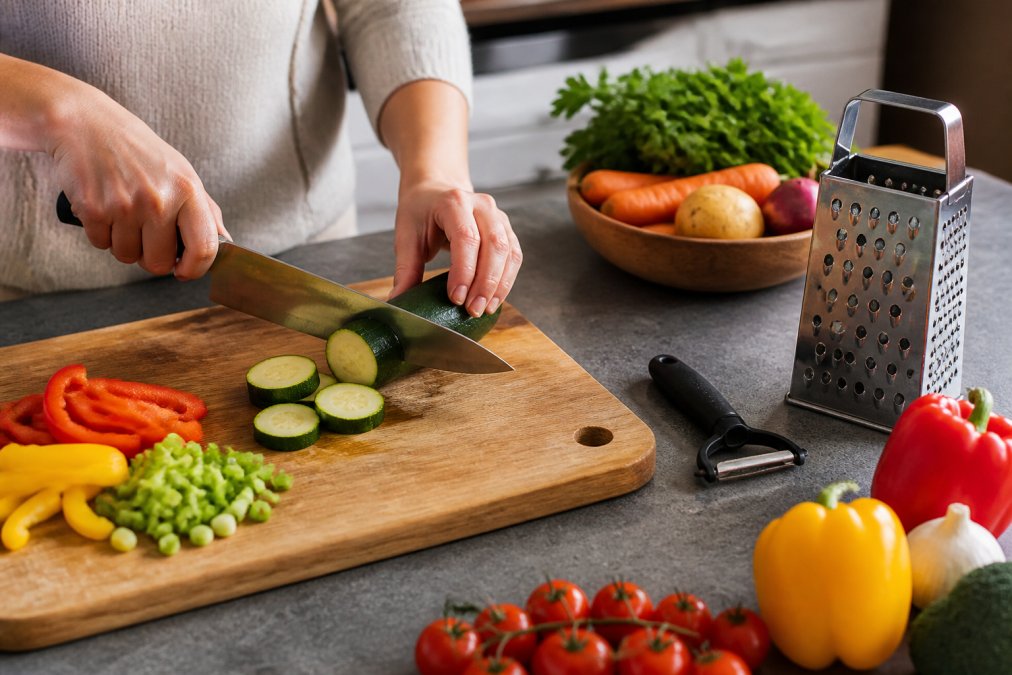
The chef's knife. An 20 cm blade is the sweet spot for most hands: long enough to rock through an onion, short enough to control.
Soap Dispenser With Palm Brush Holder →
- A peeler for potatoes, carrots and apples, a Y-peeler is faster and safer than a swivel peeler for most hands
- A box grater for cheese, garlic and ginger, the four-sided design gives you coarse, fine and slicing options in one footprint
- A microplane-style zester for citrus, once you start cooking with it, it also grates hard cheese and nutmeg
If you only buy one piece of prep kit beyond the knife, make it the board. A stable surface is what lets the knife do its job, and it is the cheapest upgrade to your cooking.
Pots, Pans and Measuring Tools: The Easy Kitchen Tools That Do the Heavy Lifting
The easy kitchen tools that carry the most weight are the ones that apply heat and measure accurately. A heavy-bottomed pot, one nonstick skillet, and a proper set of measuring cups and spoons cover boiling, simmering and sautéing.
| Tool | Job It Does | Why It Matters |
|---|---|---|
| Heavy-bottomed pot | Boiling, simmering, stews | Even heat, no scorching |
| Nonstick skillet | Eggs, fish, delicate food | Releases without sticking |
| Dry measuring cups | Flour, sugar, rice | Accurate scooping and levelling |
| Liquid measuring cup | Water, milk, oil | Spout and pour line for accuracy |
| Measuring spoons | Spices, baking powder | Consistent small measures |
Ergonomic Kitchen Tools for Hands That Tire Easily
Ergonomic kitchen tools reduce strain for anyone whose grip weakens during long prep sessions. A comfortable handle, a palm-fit grip, and a tool you can use without a tight pinch all make cooking easier on the hands.
- Choose handles that are wide and rounded, not thin and angular
- Prefer tools you can hold with a relaxed hand, not a tight pinch
- Adjustable or long handles reduce bending and reaching
- A tool that does two jobs means one less grip per session
Cleaning and Storing Your Kitchen Tools So They Last
- Knives: hand-wash and dry immediately. High heat and harsh detergent dull edges and dry out wooden handles. A knife left wet in a sink develops rust spots within hours.
- Wooden boards and spoons: hand-wash with hot soapy water, never soak, and never put in a dishwasher. Wood swells, cracks and warps when soaked. Re-oil a wooden board with food-safe mineral oil once a month, or whenever it looks pale and dry, to stop it absorbing smells and splitting.
- Nonstick pans: hand-wash with a soft sponge. Abrasive scourers and dishwasher detergent strip the coating, which is the whole reason you bought the pan.
- Cast iron: never soak and never dishwasher. Scrub with hot water and a stiff brush, dry on the hob, then wipe a thin layer of oil across the surface while it is still warm. This seasoning layer is what makes it nonstick.
- Stainless steel: dishwasher-safe in most cases, but dry it fully to avoid water spots and pitting.
A simple maintenance rhythm. Once a week, hone the chef's knife and check wooden items for dryness. Once a month, oil wooden boards and spoons, and check nonstick pans for scratches. Once a season, sharpen the chef's knife properly and tighten any loose handles. This rhythm takes minutes and is the difference between replacing a kit every two years and keeping it for ten.
Frequently Asked Questions
What are the essential kitchen tools for a beginner cook?
Start with a chef's knife, a cutting board, a nonstick skillet, a heavy-bottomed pot, a colander, measuring cups and spoons, a silicone spatula, tongs and a whisk. These nine items cover most everyday cooking: chopping, sautéing, boiling, simmering and draining. Add a peeler, grater and kitchen shears as you go. Buy the best versions of the tools you use daily, and keep the rest simple until you know what your cooking actually demands.
How do I stock a kitchen for beginners on a tight budget?
Split your budget into two groups. Spend more on the chef's knife and one heavy-bottomed pot, because these affect results every time you cook. Save on measuring spoons, mixing bowls, spatulas and colanders, where a basic version performs nearly as well. Buy one item at a time, cook with it for a fortnight, then decide what is missing. This approach stops the drawer filling with gadgets you never reach for.
Which kitchen tools are worth the investment for a new cook?
A sharp chef's knife, a heavy-bottomed pot and one good nonstick skillet repay their cost quickly through better heat distribution and longer life. Look for an ergonomic handle, a dishwasher-safe finish and oven-safe materials where the listing states it. Cheaper versions of these three wear out or warp within a year, so replacing them costs more than buying well once. Everything else can wait until your cooking habits settle.
How should I clean and store my kitchen tools so they last?
Wash knives by hand and dry them straight away, since dishwasher heat dulls the edge. Check whether each item is dishwasher safe before loading it. Wooden boards need hand washing and occasional oiling. Store knives on a magnetic strip or in a block rather than loose in a drawer, and keep silicone spatulas and tongs away from direct heat. A double-sided cleaning sponge with a scraper side handles baked-on residue without scratching nonstick surfaces.
What are the most versatile kitchen gadgets for small spaces?
Multi-purpose items beat single-task gadgets in a small kitchen. A colander that doubles as a steamer, a 4-in-1 tile brush with an integrated scraper, and a soap dispenser brush that holds washing-up liquid in the handle all offer versatile functionality. Measure your cupboard and drawer space first, then choose tools that nest or hang. Fewer, better tools keep worktops clear and prep work faster.